PROJECT DROPLET
An ECOICE Initiative
FireShield
Project+
Home Applications Pilots Prototypes Team Story FireShield Project+
FireShield Autonomous Suppression
Initial Attack & Perimeter Suppression

Fire doesn't wait for the truck. Neither do we.

The gap between
ignition and response
is where fires get away.

FireShield is a tiered, autonomous suppression system built to close that gap — continuous ground-fed suppression on the flanks and rear of a fire, aerial detection and knockdown on residual hot spots, deployed inside a defined safety envelope.

7–10
Days to mobilize
750
m/hr per team, sustained
1.0
L/m² suppression density
TAC-01 · FLANK DEPLOYMENT● LIVE
HEAD · OUT OF ENVELOPE GROUND RIG CONTROL
The Problem

Speed of response decides the cost of the fire.

Suppression budgets are consistently strained not by the fires agencies expect, but by the ones that grow past initial attack before crews and aircraft can reach them. The economics of firefighting are non-linear — a fire caught at one hectare and a fire caught at one hundred cost orders of magnitude apart.

2–3x
Typical seasonal suppression overspend against budgeted allocation in high-activity years
1:1000+
Approximate cost ratio between suppressing a fire at ignition versus at established scale
Minutes
The window in which a new ignition remains within reach of a small, fast-deploying response unit
Operational Envelope

We tell you what this system can hold — and what it can't.

Fire behavior varies by position on the perimeter. Head fire, flank fire, and back fire spread at fundamentally different rates. FireShield's throughput is benchmarked against each, using the Canadian Forest Fire Behavior Prediction System's own published spread-rate classes for boreal fuel types under moderate–high fire weather.

POSITION
Back / Rear
130 m/hr spread
720 m/hr team capacity
5.5× margin
Full coverage
POSITION
Flank
293 m/hr spread
720 m/hr team capacity
2.5× margin
Full coverage
POSITION
Head
720 m/hr team capacity
1,030 m/hr spread
Outpaced
Conventional handoff
Head fire spread consistently exceeds sustainable suppression-grade application speed, on moderate fire weather and further on extreme days — this is a physical constraint, not a resourcing one. FireShield is engineered and deployed for the flank and rear, where it holds real margin, and explicitly hands the head to conventional air tanker and retardant response. This boundary is fixed into the operating protocol, not left to field judgment.
System

Two tiers, one operating picture.

Each deployment pairs continuous ground-fed suppression with autonomous aerial response — matched to fire behavior doctrine, not built as a single do-everything platform.

Tier 01
Continuous Suppression
Ground-fed aerial units tethered to a mobile tank and pump rig, holding position along the flank and rear at a speed calibrated to suppression-grade application density — not misting, not a pass-through.
20 L/min
Flow rate
1,000–2,000 L
Ground tank capacity
≤10 m/s
Wind operating limit
150 m
Max hose deployment
Tier 02
Aerial Response
Autonomous detection and targeted suppressant drop on residual hot spots and flare-ups behind the working line — and overwatch, standing in as the mandatory lookout for every ground deployment.
25 min
Flight endurance
10 km
Control range
GPS/RTK
Positioning
Auto-drop
Release mode
Field Reference

What a deployment looks like on the ground.

Team composition, ground rig configuration, and standoff geometry for a live flank/rear deployment — control station, tanker and pump trailer, tethered suppression units, and aerial overwatch, all operated from a marked safety perimeter.
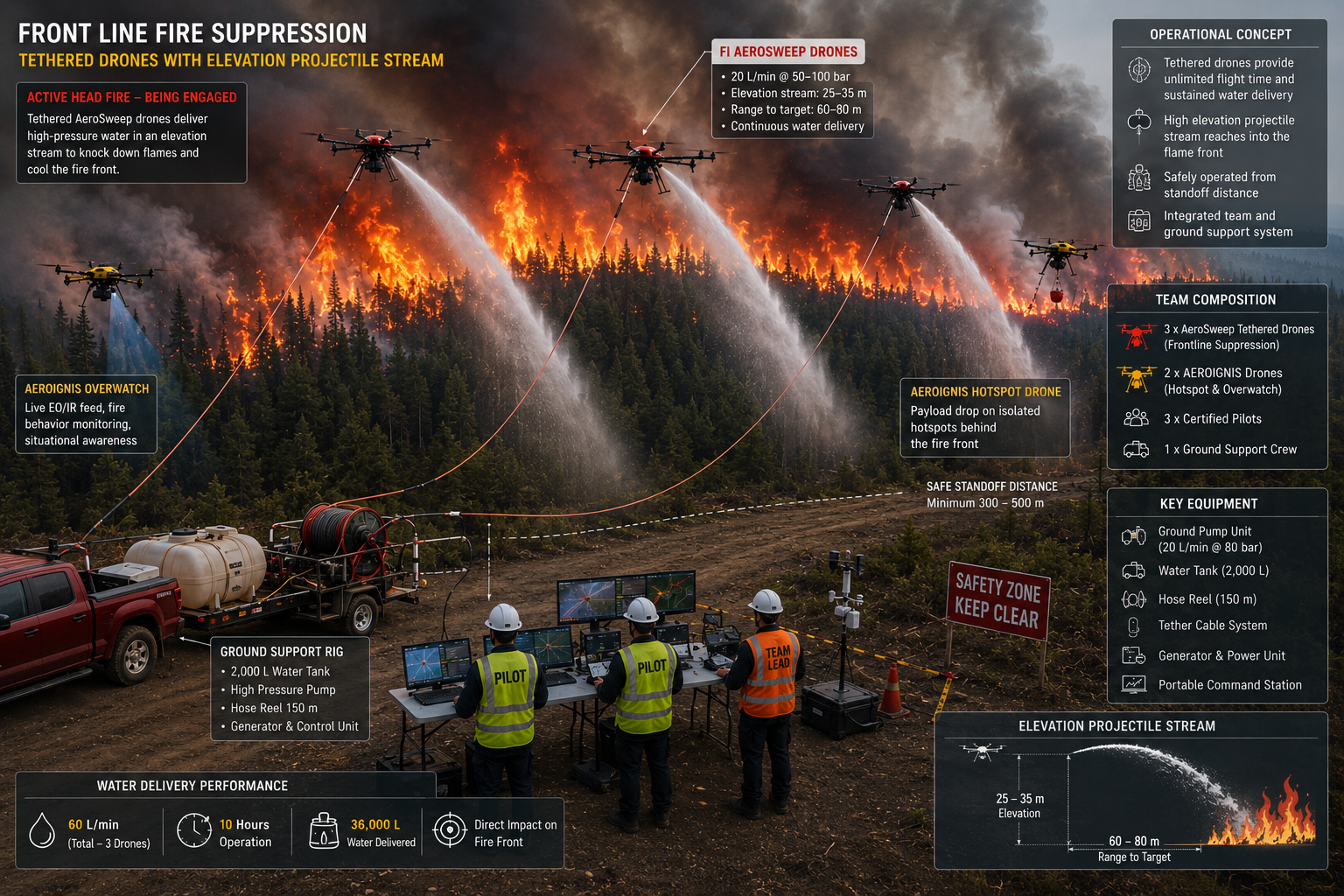
FireShield field operations diagram showing tethered AeroSweep suppression drones, AEROIGNIS overwatch units, ground support rig, and pilot control station at a marked safety standoff distance.
Reference diagram — team composition (3× AeroSweep, 2× AEROIGNIS, 3 pilots, ground crew), ground rig layout (tank, pump, hose reel, generator), and control-station standoff positioning. Fire scene shown for operational-geometry illustration; suppression targeting follows the flank/rear operating envelope defined above.
Note — flight endurance for tethered units remains battery-limited (15–18 min per cycle with quick-swap turnaround); the tether supplies continuous water, not continuous power. Figures throughout this page reflect that constraint.
Safety Protocol

Built on existing fire doctrine, not around it.

Every ground deployment runs under LCES — the same discipline wildland crews already operate by.

LOOKOUT
Aerial overwatch monitors fire behavior ahead of every ground position, continuously.
COMMS
Continuous link between ground crew, pilots, and incident command at all times.
ESCAPE
Routes confirmed passable before work begins, reassessed on a fixed interval.
SAFETY ZONE
Pre-identified fallback point within safe retreat time of the ground unit at all times.
Automatic Escalation Trigger
Ground units withdraw to the safety zone and the sector defaults to aerial-only response — a pre-agreed, binary rule — when flame length exceeds ~1.2–2.4 m, spread rate exceeds sustainable retreat speed, spotting is observed ahead of the position, or visibility drops below threshold.
Deployment

From agreement to operational, on a defined clock.

Day 0
Agreement signed. Advance payment received.
Day 1–10
Equipment, crew, and ground rig mobilized. Site walkthrough. Regulatory sign-off confirmed.
Operational
Deployment under agency operational command — initial attack and mop-up assignments.
Reporting
Verified outcomes, cost-per-hectare benchmark, and regulatory pathway delivered.

Bring FireShield into your fire season.

A scoped pilot deployment, benchmarked against your own suppression data, with a defined operational envelope from day one.

Request a Deployment Briefing →